Batteries take 61.75% of Belgian capacity auction for 2030-2031
Elia awarded 1,565.66 MW of capacity on 29 October for the 2028-2029 delivery period, in which combined-cycle gas plants remained the largest category. For the more distant 2030-2031 period, battery storage accounted for 61.75% of the awarded volume, according to PV Magazine; that figure has so far been reported by a single source.
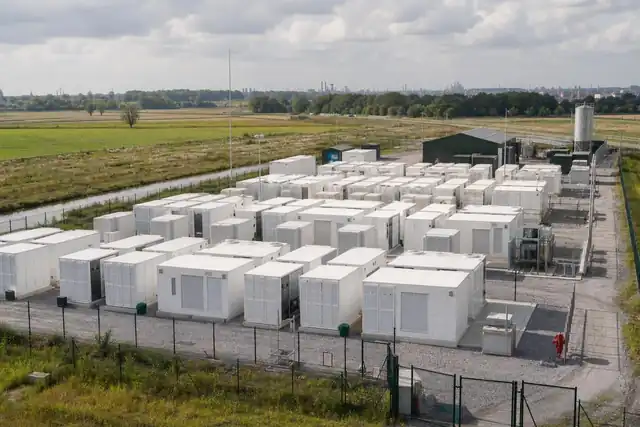
In the Y-2 auction for 2028-2029, Elia awarded a total of 1,565.66 MW, bringing contracted capacity for that period to 5.8 GW. Batteries took the second-largest share with 590.61 MW (37.72%): 464.66 MW of new-build and 125.95 MW of existing installations. Combined-cycle gas plants remained the largest category at 754.20 MW (48.17%). The auction cost roughly €34 million at a weighted average price of €21,643 per MW per year, the remuneration being for availability rather than for energy delivered.
The Y-4 auction for 2030-2031 awarded 769.28 MW; including earlier contracts, capacity for that period stands at 4.9 GW, against a supply surplus of 3.1 GW. Four-hour batteries accounted for 61.75% of that volume, while two-hour systems were not selected. The auction as a whole cost approximately €14 million at a weighted average price of €18,143 per MW per year, lower than the €21,643 seen in the Y-2 auction. A Y-4 auction has a longer horizon than a Y-2 auction, so a trend of falling prices cannot yet be confirmed on that basis.
The Y-1 auction for 2027-2028 produced no new awards: the required volume fell to zero once cross-border contributions and capacity outside the CRM were taken into account. For that period, 6.5 GW is already contracted at a cost of roughly €200 million, at €30,944 per MW per year, the highest price of the three periods. GIGA Green Turtle BV won the most capacity in both battery auctions: 239.70 and 66.30 MW for 2028-2029, and 220.90 MW for 2030-2031.
Batteries have thus secured a permanent place in Belgian security of supply, while gas plants continue to underpin that security chiefly through already-contracted long-term capacity. That new gas capacity is not redundant is evident from the empty Y-1 round: earlier contracts already carry the bulk of security there. For developers of four-hour battery systems, the outcome confirms a revenue stream; for new gas capacity in later periods, margins are set to tighten as storage becomes able to bid more cheaply.
newsroom_reader.sources
newsroom_reader.sources_news
- 1PV Magazine · 3 nov. 2026 · pv-magazine.comBatteries to dominate Belgium’s capacity remuneration mechanism
- 2www.ess-news.com · 3 nov. 2026 · ess-news.comBatteries to dominate Belgium’s capacity remuneration mechanism - Energy Storage
- 3www.byteseu.com · 31 oct. 2026 · byteseu.comBattery storage gains ground in Belgium's latest capacity market auctions - Bytes Europe